‹ Futurama: all episodes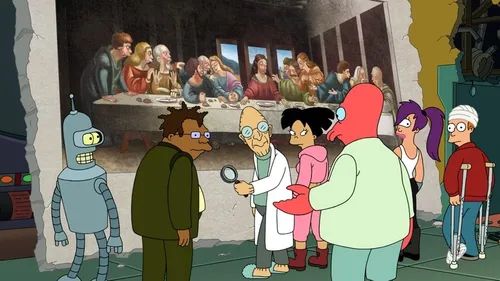
Season 6 · Episode 5
The Duh-Vinci Code
B1LatAm dubRelaxed dialogueRelaxed: slower, easier to followon Hulu
The Planet Express crew races to future Rome to unearth the shocking secret of Leonardo da Vinci.
25 words and expressions8 free to read and keep
Keep one and it comes back tomorrow, then 3 days, then a week, until you know it.
Worth remembering from this episode
Ordered by what we think matters most.
anomalía
anomaly, irregularitynoun (f)Los científicos descubrieron una anomalía en los datos del experimento.The scientists discovered an anomaly in the experiment's data.ceremonia
ceremony, ritualnoun (f)La ceremonia de graduación duró casi tres horas.The graduation ceremony lasted almost three hours.pantano
swamp, marsh, bognoun (m)El pantano al sur del pueblo alberga muchas especies de aves.The swamp south of town is home to many bird species.abertura
opening, gap, riftnoun (f)Había una abertura en la pared por donde entraba la luz.There was an opening in the wall where the light came through.expedición
expedition, missionnoun (f)El equipo de científicos organizó una expedición al polo norte.The team of scientists organized an expedition to the north pole.dar asco
to be disgusting, to gross someone outexpressioncolloquialA very common fixed expression in Latin American Spanish. 'Asco' (disgust, nausea) pairs with 'dar' to express strong repulsion toward a person, thing, or situation. It ranges from mild to quite strong depending on tone.
Me da asco cuando alguien masca con la boca abierta en el cine.It disgusts me when someone chews with their mouth open at the movies.fango
mud, mire, sludgenoun (m)Los niños jugaron en el fango después de la lluvia.The kids played in the mud after the rain.cursi
cheesy, corny, sappy, over-sentimentalexpressioncolloquialDescribes something excessively sentimental, tacky, or trying too hard to be romantic or touching. Very widely used across Latin America to dismiss overdone displays of affection or bad taste.
Me regaló un osito de peluche gigante; fue lo más cursi que he visto en mi vida.He gave me a giant stuffed bear; it was the cheesiest thing I've ever seen in my life.
8 worth keeping from this episode. Free to read and keep.
An account is all it takes to keep them.
What Pro opens
- 11 more words and 6 more expressions here, and every entry in every other pack.
- Examples spoken in the show’s own dialect, not a browser voice.
Get Pro ›$59 $29.50 a year, or $8 $4 a month in USD. Early bird, 50% off for life. Cancel anytime.