‹ Green Frontier: all episodes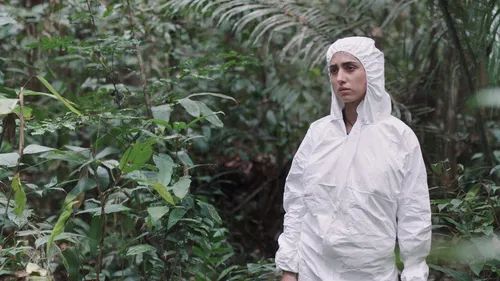
Season 1 · Episode 1
The Deep Jungle
C1Colombian40 min on Netflix
 Colombianon Netflix
The murders of four missionary women bring Helena, a detective, to the deep jungle. Years before, Yua and Ushe are tasked with protecting the jungle.
27 words and expressions11 free to read and keep
Keep one and it comes back tomorrow, then 3 days, then a week, until you know it.
Worth remembering from this episode
Ordered by what we think matters most.
selva
jungle, rainforestnoun (f)La selva amazónica es el pulmón del planeta.The Amazon rainforest is the lung of the planet.cuerpo
body, corpse (in investigative context)noun (m)La médica examinó el cuerpo antes de que llegara la fiscalía.The doctor examined the body before the prosecutor's office arrived.tribu
tribenoun (f)Esa tribu lleva generaciones viviendo en lo profundo de la selva.That tribe has been living deep in the jungle for generations.fiscalía
prosecutor's office, attorney general's officenoun (f)La fiscalía abrió una investigación formal por el caso.The prosecutor's office opened a formal investigation into the case.no contactados
uncontacted peoples (indigenous groups with no official contact with outside world)noun phrase (m pl)Los grupos no contactados del Amazonas están protegidos por ley.The uncontacted groups of the Amazon are protected by law.flecha
arrownoun (f)Encontraron una flecha clavada en el árbol junto al camino.They found an arrow embedded in the tree beside the path.fresco
relax, don't worry about it, take it easyexpressioncolloquialUsed as a standalone reassurance or instruction, not describing temperature. Tone is calming or dismissive depending on context. Very common in everyday Colombian speech.
Fresco, yo me encargo de hablar con el jefe.Don't worry, I'll take care of talking to the boss.camine
let's go, come on, move itexpressioncolloquialIn Colombian Spanish, 'camine' (literally 'walk') is used as an informal imperative meaning 'let's go' or 'come on'. It does not always involve walking; it simply signals it's time to leave or get moving.
Camine, que se nos va el bus.Let's go, we're going to miss the bus.resguardo
indigenous reserve, legally protected indigenous territory in Colombianoun (m)El resguardo indígena tiene sus propias autoridades y leyes internas.The indigenous reserve has its own authorities and internal laws.tocaba
it had to be done, there was no choice but toexpressioncolloquialThe imperfect of 'tocar' used impersonally to mean 'it was necessary' or 'there was no other option'. Extremely common in Colombian Spanish to justify an action as unavoidable. Not to be confused with tocar meaning 'to touch'.
Tocaba salir temprano para llegar antes del tráfico.We had to leave early to get there before the traffic.
vulgar1 more entry, marked strong language because the episode uses it.Show itHide it
está muy jodido
it's really tough, it's seriously messed up, it's going to be very difficultexpressionvulgarJodido is a versatile word in Colombian informal speech. In this usage it signals a situation that is very difficult or practically impossible. Can also mean broken or ruined depending on context.
Encontrar trabajo en esa ciudad está muy jodido ahora mismo.Finding work in that city is really tough right now.
11 worth keeping from this episode. Free to read and keep.
An account is all it takes to keep them.
What Pro opens
- 10 more words and 6 more expressions here, and every entry in every other pack.
- Examples spoken in the show’s own dialect, not a browser voice.
Get Pro ›$59 $29.50 a year, or $8 $4 a month in USD. Early bird, 50% off for life. Cancel anytime.