‹ Between Lands: all episodes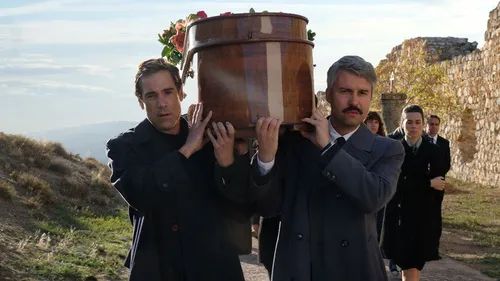
Season 1 · Episode 4
Capítulo 4
B2Castilian60 min on Netflix
 Castilianon Netflix
After a macabre discovery, Manuel becomes the main suspect in a crime. María struggles to find evidence to prove her husband's innocence.
27 words and expressions11 free to read and keep
Keep one and it comes back tomorrow, then 3 days, then a week, until you know it.
Worth remembering from this episode
Ordered by what we think matters most.
enterrar
to buryverbVan a enterrar a su abuelo el jueves por la mañana.They are going to bury her grandfather on Thursday morning.herencia
inheritancenoun (f)Cuando murió su padre, los tres hijos se repartieron la herencia.When her father died, the three children divided the inheritance.lo acompaño en el sentimiento
my condolences, I'm sorry for your lossexpressionformalThe standard formal expression of condolence used at funerals or when someone has died. More ceremonial than 'lo siento mucho'. Almost always used in face-to-face situations with bereaved people.
Se acercó a la viuda y le dijo: 'La acompaño en el sentimiento'.He went up to the widow and said: 'My condolences'.autopsia
autopsy, post-mortemnoun (f)Los resultados de la autopsia tardaron varios días en llegar.The autopsy results took several days to arrive.detenido
arrested, detainedadjective / past participleLa policía dejó al sospechoso detenido durante cuarenta y ocho horas.The police kept the suspect detained for forty-eight hours.dote
dowrynoun (f)En el pasado, la dote pasaba del padre de la novia al futuro marido.In the past, the dowry passed from the bride's father to her future husband.mosquita muerta
someone who looks innocent but is actually cunning or sly; butter-wouldn't-melt typeexpressioncolloquialDescribes a person who presents a meek or innocent facade but is calculating or two-faced underneath. Often said with a tone of contempt or suspicion.
Parece muy tímida, pero no te fíes: es una mosquita muerta.She seems very shy, but don't trust her, she's a sly one.se te ocurre
you think of, it occurs to you (used to express disbelief at someone's idea or action)expressioncolloquialThe phrase '¿cómo se te ocurre?' is a set expression meaning 'what were you thinking?' or 'how could you do/say that?'. It expresses surprise, reproach, or disbelief at someone's behaviour.
¿Cómo se te ocurre llamar a tu jefe a las tres de la mañana?What were you thinking, calling your boss at three in the morning?esfumarse
to vanish, to disappear into thin airverb (pronominal)El dinero que dejé en la mesa se ha esfumado.The money I left on the table has vanished.ataúd
coffinnoun (m)Pusieron flores blancas encima del ataúd.They placed white flowers on top of the coffin.
vulgar1 more entry, marked strong language because the episode uses it.Show itHide it
me cago en los muertos de
a very strong curse directed at someone, roughly 'damn you and your dead'expressionvulgarOne of the most offensive curse structures in everyday speech. It invokes insult to a person's deceased relatives. Used in moments of intense anger or frustration. Never appropriate in formal or polite contexts.
Cuando se dio cuenta de que le habían robado el coche, soltó un '¡me cago en los muertos!' en medio de la calle.When he realised his car had been stolen, he let out a furious curse in the middle of the street.
11 worth keeping from this episode. Free to read and keep.
An account is all it takes to keep them.
What Pro opens
- 10 more words and 6 more expressions here, and every entry in every other pack.
- Examples spoken in the show’s own dialect, not a browser voice.
Get Pro ›$59 $29.50 a year, or $8 $4 a month in USD. Early bird, 50% off for life. Cancel anytime.